
Beyond the Mirror: Analyzing the Quest for Individuality in The Quintessential Quintuplets
- 6 days ago
- 4 min read
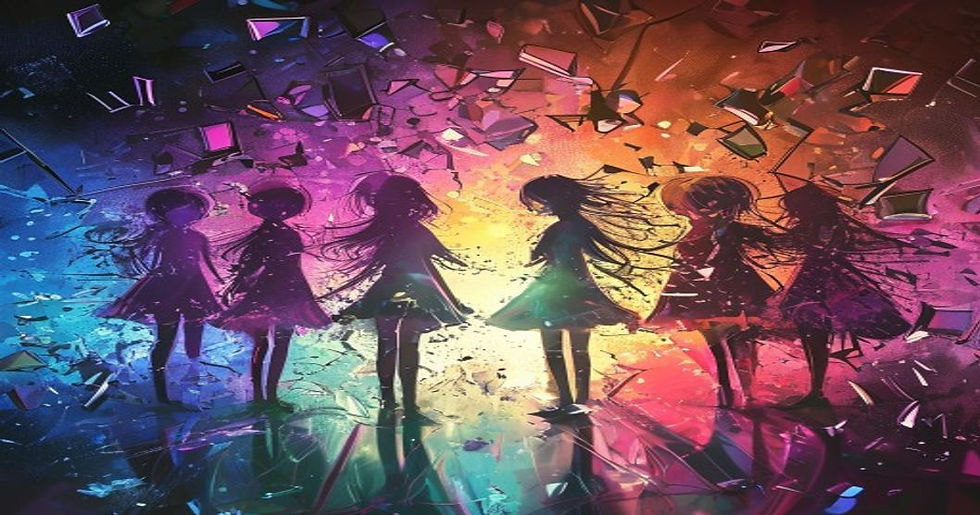
Breaking Away from 100% Similarity: Quantifying the Quintuplets' Search for Self
Think back to the opening scenes of the story. Ichika, Nino, Miku, Yotsuba, and Itsuki—sitting side by side. The same faces, the same hairstyles, the same aura. To the reader, the initial impression is one of overwhelming sameness: "They aren't just twins; they are a single, unified set." At that point, their "facial similarity" could easily be rated at nearly 100%. Yet, as the story unfolds, that number steadily, inexorably, begins to diverge as each girl carves out her own "individual."
This isn't merely a romantic tale about who ends up with whom. It is a chronicle of identity—a struggle to break the "curse" of their shared DNA and prove that they exist as separate beings.
The Invisible Borders within a Shared Space
In the early chapters, the sisters' living space feels remarkably borderless. The same house, the shared rooms, the communal meals. They share physical walls, and their personal territories bleed into one another. You often see personal belongings scattered haphazardly, appearing as if they belong to everyone and no one at once.
However, if you look closely, you'll notice how they use their possessions to create "invisible partitions" to maintain a sense of self. Miku’s constant presence with her headphones, or Nino’s preference for fashion and accessories that project a certain strength—these aren't just hobbies. In a shared space without physical barriers, these items serve as "landmarks" to secure their personal territory.
In architecture, there is a concept called "zoning"—using furniture or layout to create invisible walls that separate private areas from social ones. The quintuplets do exactly this through their belongings and behaviors. They establish an unconscious boundary that says, "This much is mine." They are constructing a territory that is impossible to quantify, using objects as tools for self-defense.
When you re-read the story through this lens, their choice of fashion and accessories looks less like mere style and more like "banners of self-assertion," used to trace the outlines of their identities within the room.
The Comfort of Sameness and the Terror of Erasure
In the middle of the series, there are scenes—like during mealtime—where all five sisters eat in perfect unison. In these moments, the reader feels a sense of "quintessential unity." The shared rhythm and shared food provide a comforting sense of belonging to a group.
But as we follow the internal conflicts of characters like Ichika and Nino, we realize that this comfort is inextricably linked to the fear of being erased. Specifically, in scenes where Ichika struggles to balance her role as the eldest sister with her true desires, the way her expressions are drawn is masterful. She is caught between her personal will and her identity as a piece of a "set."
Many romance stories define individuality through "differences in personality." This story, however, operates on a much higher stakes premise: an inescapable, extreme level of similarity. Because they share the same faces and the same environment, the "cost" of stepping forward and declaring, "I am different from the other four," is incomparably higher than in any other series.
The drama lies in the violent collision between the desire to belong (the comfort of the group) and the hunger to exist (the longing for the individual). It is this struggle for self-determination under such inescapable circumstances that pierces the reader's heart.
Yotsuba’s Decision: Breaking the Wall of Expectations
Toward the end of the story, Yotsuba’s character arc becomes pivotal. Among the five, she was the one who prioritized "group harmony" above all else. While the others were striving to establish their individual selves, Yotsified stayed within the symbolic role of the "cheerful, supportive sister."
Around chapter 90, there is a moment where the camera captures her eyes in a tight, quiet close-up, revealing a look of suppressed agony. This is the moment she begins to break free from the role of the "quintuplet stabilizer"—a role that was convenient and comfortable, but ultimately stripped her of her "self."
For her, acting "brightly, just like the others" was the easiest way to maintain peace. But by doing so, she risked becoming nothing more than a "functional part" of a group. She chose, through her own will, to tear down the "wall of roles" that imprisoned her.
In architectural terms, this is a dynamic transformation—like intentionally demolishing functional partitions to create an entirely new, expansive space. By refusing to be confined to a predefined role and allowing herself to show vulnerability, the story evolves from "a story of the quintuplets" into "a story of five individual girls." The moment she stops hiding her pain, the reader realizes that she is no longer just "one of the quintuplets," but "Yotsuba, the individual."
The Final Form: The Completion of the "Five"
In the series finale, when the choice is finally made, the ultimate answer to the story’s central question is revealed.
The girls, who were once depicted as a single, identical "set," finally stand before us as independent beings, each possessing a distinct will. They can no longer be lumped together under the single label of "the quintuplets."
If we were to quantify the "strength of their individual identities" at the beginning versus the end, the final value is incomparably higher than the start. It isn't just that their personalities have diverged; their very existences have been sublimated into something independent and irreplaceable.
Ichika, Nino, Miku, Yotsuba, and Itsuki. They chose to transcend the strongest bond of similarity: their blood. They did so to ensure that their existence was something unique, shared by no one else.
Perhaps the reason this story resonates so deeply, moving beyond the boundaries of a simple rom-com, is because it provides a beautiful answer to the question we all face in our daily lives: "Who am I?" Through them, we witness the magnificent establishment of the self.


Comments