The Geometry of Magic: Decoding the Precision of *Witch Hat Atelier*
- 57 minutes ago
- 3 min read

Hello, I’m Misaki.
There is a certain magic in watching a wizard’s pen move across paper—the sensation of the world being rewritten with every pulsing stroke of ink. It is a moment that always leaves me breathless. Today, I want to attempt something a bit different: quantifying the "precision of the line" that allows magic to manifest.
Beyond Incantations: Geometry as the Architect of Reality
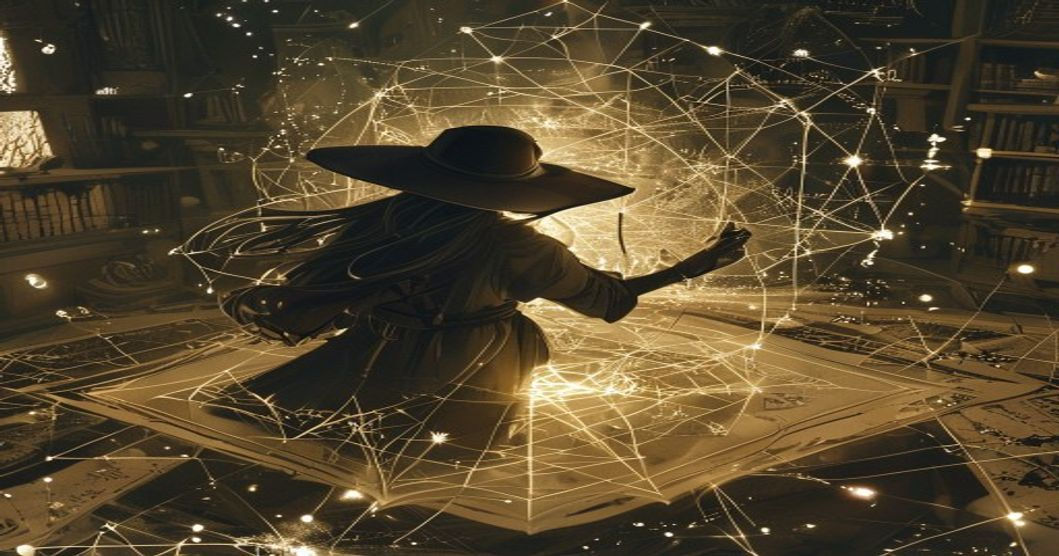
In the opening of Volume 1, there is a scene where Coco peeks secretly into a magic book. What she finds isn't the "incantations" we are so accustomed to in fantasy. Instead, there are intricate, geometric trajectories of ink, imbued with a profound mathematical beauty.
In most fantasy works, magic is triggered by the resonance of spoken words—phrases like "Fire, ignite!" However, the magic in *Wagari* (*Witch Hat Atelier*) is fundamentally different. Magic is not something you chant; it is something you draw. It does not rely on the ambiguity of language, but on the fixed, undeniable information of geometry to trigger physical phenomena. The essence of magic here is not a prayer whispered to the heavens, but a "precise blueprint" rendered in ink.
This setting lends the series a unique sense of grounded reality. When a mage holds a magic book, it feels as though they haven't just gained access to supernatural power, but have acquired a "highly advanced technical manual" for rewriting the laws of the world.
Quantifying the Error: The Impact of a Misplaced Line
If we were to observe the process of drawing a magic circle (a rune) through the lens of reading an architectural blueprint, what would happen if we quantified the "precision of the line"?
Consider the boundaries of a rune—the overlapping strokes and the arcs of its curves. I have a hypothesis: if a single line were to shift by a mere 0.5mm, perhaps the duration of the spell would plummet to just 50% of its intended strength. Furthermore, if the density of the ink at the intersections dictates the "programmatic" strength of the design, then an error in execution could potentially reduce the spell's destructive power by over 30%.
While this is purely speculative, the details within the manga lend weight to such a theory. Just as a line in architecture is not a mere symbol but a command that defines a physical "wall" or "boundary" in space, a line in a rune defines the pathway for magical energy. The precision of the stroke directly dictates the output and stability of the magic. This "obsession with technical accuracy" provides the magic in this world with an incredibly robust logical foundation.
When Technical Mastery Ascends to Art
There are moments when technical accuracy transcends being a "correct answer" and transforms into breathtaking beauty. A prime example is the scene in Volume 2 where Kiefree wields the "Magic Sword of Water Splitting." As the magical item cleaves through the water, the drawn patterns glow with a vivid, dynamic brilliance.
I don't believe this beauty is merely a visual flourish. In architecture, there is a concept known as "tectonics"—the idea that structural integrity and aesthetic beauty are inextricably linked. When the arrangement of lines and the structural necessity of the runes reach a state of perfection, we are witnessing the moment where technical skill is sublimated into art.
The magical patterns function not just as shapes, but as programs for physical space. Their structural correctness manifests as a radiance that strikes the heart. Here, technique, beauty, and raw magical power all support one another.
The Perilous Boundary: When a Mistake Becomes a Tragedy
However, this precise blueprint carries a terrifying risk. We see this in the tragic childhood memory of Coco, whose carelessness caused her mother to turn to stone. In that moment, the mechanism of magic shifted from a "convenient tool" to an "uncontrollable catastrophe."
Because magic is an act of "drawing," an error is not merely a failure; it is a fundamental mistake in the blueprint. A single stray stroke, a single misplaced line, can rewrite the definition of physical reality in an irreversible way. The very "line" intended to define a boundary ends up causing that boundary to collapse.
The magic in this series carries a heavy ethical weight: technical error translates directly into a threat to life. Behind the beautiful, intricate, and overwhelming power of this magic lies a bone-chilling tension—the knowledge that even the slightest tremor of the pen cannot be permitted.
---
**Works featured in related articles:** *Frieren: Beyond Journey's End*, *Re:Zero − Starting Life in Another World*
Please check out my other articles as well!



Comments